China's stainless steel market eyes stability as Jun'26 production cuts begin
...
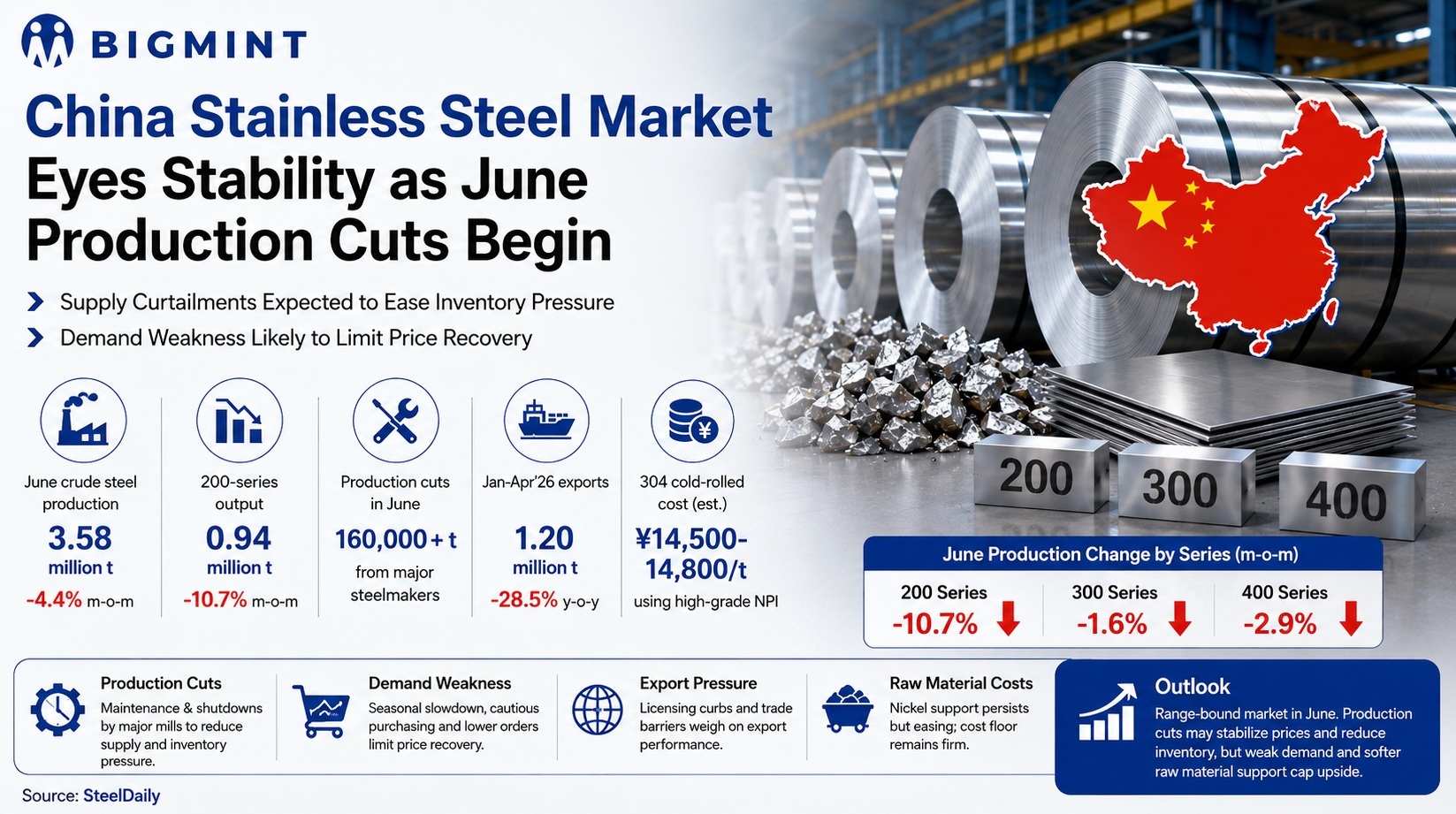

- Supply curtailment expected to ease inventory pressure
- Demand weakness likely to limit price recovery
SteelDaily: China's stainless steel market is entering a phase of planned production cuts and maintenance shutdowns in June, raising expectations of improved market balance amid persistent oversupply concerns. While seasonal demand remains weak due to the traditional off-season, market participants anticipate that reduced output could help stabilize prices by lowering inventories and easing supply pressure.
According to market estimates, China's stainless steel crude steel production is expected to reach 3.58 million t in June, down 4.4% m-o-m. The sharpest decline is projected in the 200-series segment, with output expected to fall by 10.7% to approximately 0.94 million t. Production of 300-series and 400-series grades is also forecast to decline by 1.6% and 2.9%, respectively.
The production cut momentum has gained further support following China's Ministry of Industry and Information Technology's (MIIT) announcement of revised steel capacity replacement regulations, which now include stainless steel capacity under regulatory oversight.
Several major stainless steel producers, including Baogang Desheng, Taigang Stainless Steel, and Hualer Alloy, have announced maintenance schedules during June. Total production losses from these shutdowns are estimated to exceed 160,000 t.
One major Jiangsu-based producer is expected to suspend operations for nearly 26 days beginning 6 June for equipment maintenance, resulting in an estimated production loss of around 65,000 t. The impact is expected to be concentrated in 200-series narrow-width products, with potential spillover effects on regional supply availability.
Market participants expect the production cuts to reduce the circulation of 200-series narrow-width material and 300-series cold-rolled stainless steel, helping alleviate inventory pressure. However, the extent to which supply reductions translate into price gains remains uncertain amid subdued downstream demand.
Seasonal demand remains weak
June typically marks the seasonal slowdown period for stainless steel consumption in China. Demand from key end-use sectors such as construction, kitchenware, home appliances, and industrial manufacturing remains sluggish.
Pipe manufacturers have reported lower order inflows and transaction volumes compared to previous years, prompting buyers to continue purchasing only on a need-based basis. The cautious procurement strategy is expected to limit any substantial recovery in stainless steel prices despite supply-side adjustments.
Export challenges continue
China's stainless steel export market remains under pressure. During January-April 2026, the country's stainless steel exports totaled approximately 1.20 million t, down 28.5% y-o-y.
Market sources attribute the decline primarily to the implementation of export licensing requirements and increasing trade protection measures in several overseas markets, which have reduced export competitiveness and shipment volumes.
Raw material support persists but weakens
In the raw material segment, nickel continues to provide underlying cost support to stainless steel prices. Concerns regarding nickel supply remain due to Indonesia's reduced mining quotas and ongoing conversion of certain nickel pig iron (NPI) facilities toward nickel matte production.
Several rotary kiln electric furnace (RKEF) operations in Indonesia's Kalimantan region are expected to shift part of their production from NPI to nickel matte beginning in June, potentially reducing high-grade NPI availability by around 2,600 mt of nickel content per month.
However, cost pressures have eased somewhat after Indonesia excluded NPI from its export integration policy, reducing concerns over additional supply constraints compared with May.
Meanwhile, TISCO maintained its June purchase price for high-carbon ferrochrome at RMB 8,295 per 50 base tons, indicating continued stability in the ferrochrome market. The 400-series stainless steel segment also continues to exhibit a relatively weak but stable pricing trend.
Current production costs for cold-rolled 304 stainless steel produced using high-grade NPI are estimated at Yuan 14,500-14,800/t. Market participants note that while alloy raw material costs continue to provide a price floor, their ability to drive further price increases has weakened significantly.
Outlook
Market sentiment for June remains cautiously balanced. Planned production cuts are expected to help reduce inventories and improve supply-demand fundamentals, potentially supporting a mild price recovery during the second half of the month.
However, weak downstream demand, cautious buyer sentiment, and softening nickel cost support are likely to cap any significant upward movement. As a result, China's stainless steel market is expected to remain range-bound in the near term, with average June prices likely to trend below May levels despite ongoing supply-side adjustments.
Note: This article is published as part of a content exchange agreement between SteelDaily and BigMint.
