China's coal market splitting in two: Cleaner coal sells, lower quality struggles
...

- Premium coal prices firm; lower-quality rates discounted
- Storage risks forcing quicker sales of lower-grade coal
The Chinese domestic thermal coal market is not moving as a single, unified whole. A clear and growing divide has emerged between different grades and qualities of coal. While overall demand remains weak, certain types of coal are commanding premium prices and finding buyers, while others are being discounted and left unsold. Understanding this split is key to reading the true state of the market.
The two-tier market
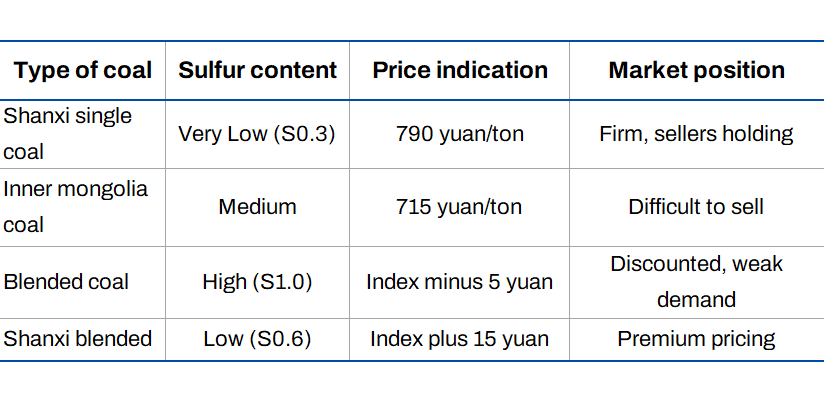
At the northern ports, traders report a distinct separation. Low-sulfur, low-ash coals, particularly those originating from Shanxi province, are holding firm. Sellers of these grades are in no rush to offload their stockpiles. Some are even holding back, confident that the quality will retain value. In contrast, medium-to-high sulfur coals and those from Inner Mongolia are facing significant resistance. Buyers are simply not willing to pay high prices for these grades.
This is not a subtle difference. Price quotes for the same calorific value can vary widely based on quality. For example, a high-quality Shanxi coal with very low sulfur was offered at RMB 790/t. Meanwhile, a blended coal with higher sulfur content was offered at a discount to the index price. The market is clearly signaling that not all coal is equal.
Storage factor
One practical reason for this divergence is storage capability. Low-sulfur, high-quality coals, especially from Shanxi, can be stored for long periods without degrading. Sellers can afford to wait for better prices. On the other hand, some Inner Mongolia coals have a higher risk of spontaneous combustion if left in stockpiles for too long. Owners of these coals are more motivated to sell quickly, even at lower prices, to avoid losing their inventory entirely.
This creates a self-reinforcing cycle. Buyers know that high-sulfur coals are being sold under pressure, so they wait for discounts. Sellers of premium coals see no such pressure, so they hold firm. The gap between the two tiers widens.
What this means for the market
This quality-driven divergence has several implications. First, it means that average price indices can be misleading. A flat or slightly rising index may hide the fact that some grades are rising while others are falling. Second, it rewards traders and logistics providers who can handle and store different coal types appropriately. Those with facilities to store low-sulfur coal safely have an advantage.
Finally, it suggests that Chinese buyers are becoming more sophisticated. They are not simply buying "coal" by calorific value. They are buying specific chemical profiles that suit their power plants and industrial processes. This trend is likely to continue, making quality differentiation an increasingly important factor in the Chinese domestic market.