China's coking coal futures soar as Mongolian fuel crunch threats coal trucking
...
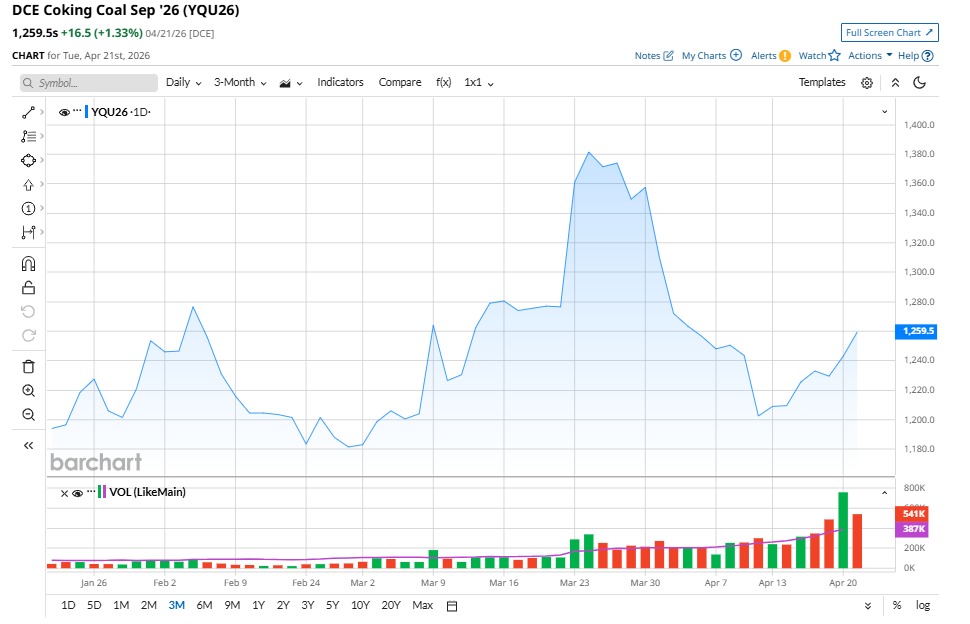

- Mongolia fuel shortage fears pushed Dalian Commodity Exchange coking coal futures up around 3%
- Shipments steady for now, backed by inventories at Erdenes Tavan Tolgoi JSC
Mysteel Global: Chinese coking coal futures prices witnessed an abrupt lift on April 20, as the imminent fuel shortages in Mongolia, the largest coking coal supplier to China, have reportedly posed threats to the two countries cross-border coal shipments which rely heavily on road transport. This has fueled market concerns over the availability of Mongolian coal for Chinese steelmakers and coking plants, Mysteel Global notes.
The most-traded September coking coal contract on the Dalian Commodity Exchange surged by 3.13% on Monday morning - its strongest single-session gain in nearly a month - before closing the daytime trading 2.77% higher at Yuan 1263.5/tonne ($185.3/t). The sharp rally in coking coal futures also provided broad support to the ferrous complex, lifting contract prices for rebar, hot-rolled coil, iron ore, and coke as well.
The marked futures gains followed widespread market chatter that fuel shortages in Mongolia - caused by elevated global oil prices amid persistent Middle East tensions - have affected truck transport capacity lately. This has led to reduced coal loadings from Erdenes Tavan Tolgoi JSC (ETT) - Mongolia's largest state-run coking coal mining group - from April 15, with Chinese coal traders reporting limitations in loading long-term contract coal cargoes.
The rumour quickly boosted market sentiment in the morning, demonstrating growing concerns about coal supplies from Mongolia, which contributes over 60% of China's coking coal imports from all sources.
The market jitters mainly reflect Mongolia's current fuel crisis as the country's crude oil supply relies entirely on imports - 80-95% from Russia and 5-20% from China. At least 40% of Russian oil export capacity has already been halted so far, as per Reuters estimation. Therefore, coal mining and transportation activities in Mongolia are anticipated to wind down to some extent in the near future.
Recent diesel price rises in Mongolia could translate to a total hike of more than Yuan 200/t in truck transport costs, some market sources expect. For coal flows to China's Ganqimaodu, the largest gateway for Mongolian coal exports to China, this will mainly impact logistical costs for Mongolia's 240-km route from Tovan Tolgoi pithead to Tsagaan Khad stockyard and the 30-km cross-border route from Tsagaan Khad to Ganqimaodu.
However, this rising fuel prices have yet to exert obvious impacts on cross-border transportation of Mongolian coal so far. Mysteel's monitoring data indicated that the coal truck traffic through the three major China-Mongolia inland ports - Ganqimaodu, Ceke and Mandula - totalled 43,912 units as of April 18, higher by a modest 2% than the corresponding period last month.
Truck traffic through Ganqimaodu, a major conduit for premium coking coal exports, only posted a small 0.34% drop to reach 22,080 units over the same period, the data showed. Sources also noted that some traders slowed new bookings of the commodity amid high stockpiles at border ports and falling selling prices, which also contributed to lower coal shipments.
In a meeting in mid-April, ETT estimated that its existing coal inventories - including 3.2 million tonnes at pithead and 1.1 million tonnes at Tsagaan Khad - can sustain normal coal shipments for around 23 workdays, based on April's average traffic of 1,378 units per day at Ganqimaodu port, Mysteel learned.
Looking ahead, some participants remain optimistic about the overall coking coal supply from Mongolia, while others warn of longer-term negative impacts from the country's fuel shortages.
Mongolia has undergone several fuel shortages amid geopolitical conflicts in recent years. When the Russia-Ukraine conflict broke out in 2022 and the Red Sea crisis started in 2023, the then-elevated international oil price rallies once sent the trucking rates for coal from Mongolia's Tsagaan Khad to China's Ganqimaodu higher by 197% in two weeks by late March 2022 and 62% in over a month by early December 2023, respectively, according to Mysteel's tracking data.
On April 20, the trucking rate for the route registered Yuan 65/t, standing still since early January, the data showed.
Note: This article has been written in accordance with a content exchange agreement between Mysteel Global and BigMint.
