China: Coking coal supply assurance narrative disrupted following Shanxi mine accident
...
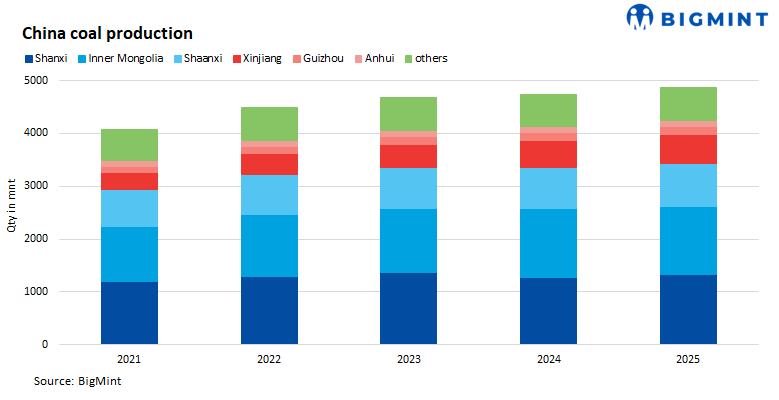

- Tight safety inspections in some provinces to keep supplies tight
- Chinese import coal arbitrage window usually opens at RMB 1,350/t ($200/t)
Horizon Insights: The biggest event that disrupted the previous "supply assurance" narrative for coking coal was the mining accident over the weekend, which shifted the policy priority back toward production safety. Based on historical precedents, the production suspension in Qinyuan County may last for approximately one month, representing the primary source of production losses arising from this incident. Output from other regions is expected to gradually recover after around one week.
Overproduction unlikely
However, from a medium- to long-term perspective, this accident suggests that many enterprises have not fully complied with mining regulations. As a result, even after production recovers, output is unlikely to return to previous peak levels, making another phase of overproduction less likely. Going forward, overall production intensity is expected to remain broadly comparable to levels seen in the third and fourth quarters of last year.
Discount in futures market
As the coking coal balance sheet improves in June, the near-term objective for the futures market is likely to be the closure of the discount to spot prices, while the ultimate upside target will depend on the extent to which near-term spot tightness can be alleviated. In addition, with steel production remaining profitable and no apparent risk of a negative feedback loop, there should be limited resistance to the transmission of higher coke prices into coking coal prices.
The upper-bound valuation for DCE coking coal futures can be benchmarked against seaborne Australian coking coal prices - specifically the price level at which the Chinese import arbitrage window reopens. This level is estimated at around RMB 1,350/t (around $200/t).
Production impact
Current production suspensions fall into two categories:
1) The accident site, including Qinyuan County and Changzhi City. All coal mines in Qinyuan County, Changzhi, Shanxi have suspended production. The total number of mines amounted to 25, with a combined capacity of 25.6 mnt/year (including one mine under long-term suspension and two thermal coal mines). Based on the latest survey findings, the affected raw coal daily output is approximately 105,300 t. The relevant authorities of Changzhi City will conduct a comprehensive safety inspection across the coal sector and continue to identify and rectify safety hazards.
2) Peripheral regions outside the accident site. Other areas in Shanxi beyond Changzhi have also begun safety inspections in succession. Lliang added 11 mines newly suspended for self-inspection, with a combined capacity of 12.9 mnt, affecting raw coal daily output by 55,000 t, with suspension periods of three-four days.
Safety regulations in Jinzhong have also tightened, with all coal mines in Pingyao County beginning three-day self-inspection suspensions. Lingshi has verbally notified all mines to halt underground production, with relevant authorities conducting mine-by-mine safety hazard checks. The number of newly suspended mines in Jinzhong reached 29, with a three-five-day suspension period and a combined capacity of 26.4 mnt, and affected raw coal daily output of 74,000 t. The remaining mines in the region have not yet suspended production, but have begun self-inspection and indicated plans for subsequent suspensions.
Safety supervision of coal mines in Linfen has also been upgraded, with some mines in Puxian, Hongtong, and Yaodu District beginning self-inspection, though the scope of suspensions is relatively limited. Linfen currently has 10 newly suspended mines, with suspension periods of approximately three days, a combined capacity of 14.3 mnt, and affected raw coal daily output of 56,700 t. The suspension periods for this group of mines are mostly three-five days, involving a capacity of 78.9 mnt and affecting raw coking coal daily output by 288,000 t.
Low inventories
From an inventory perspective, upstream inventories are currently at a historical low compared to the same period in recent years. Compounded by a significant supply loss, upstream inventories will undergo sustained drawdown, with a significant drop in sales availability. These will promote a rise in spot prices. Over the weekend, some areas in
Shanxi have already seen spot sales suspended.
For the futures market, this is unambiguously a dual improvement in both fundamentals and expectations. Futures have been declining over some time, with valuations at a discount relative to spot prices. This discount is partly attributable to the regulatory supply assurance expectations and partly reflects early pricing of the marginal weakening of June fundamentals.
As supply assurance has now given way to safe production requirements, the inventory accumulation pressure in June will likely improve significantly. The immediate objective for the futures market is to close the discount to spot, while the ultimate target depends on the level at which near-term spot tightness can be resolved.
Furthermore, based on the current steel mills margins, it is likely they will accept price increases. The rally in ferrous metals from mid-April through May has exhibited a clear margin-expansion characteristic. Moreover, the inventory at the coking plants is not high.
After the fourth round of coke price hikes is implemented, expectations for a fifth and sixth round remain in place. The overall transmission chain of steel mill margins coke coking coal currently faces no resistance, and demand-side negative feedback is not a concern.
Mongolian supplies already high
With the accident, there is no doubt that domestic mine output will drop. On the other hand, Mongolian coal haulages are already at elevated levels and have been priced in by the market, leaving little room for incremental supply. Furthermore, the import intensity of Mongolian coal in the second half of the year could fall below that of the first half.
Taking ETT (Erdenes Tavan Tolgoi) as an example, Q1 production was 8.7 mnt and sales were 9.5 mnt; given its annual production plan of 35 mnt, there is limited scope for a meaningful increase in subsequent output. As Mongolia's own inventories are gradually drawn down, an overselling position cannot be sustained over the long term.
Import window
With that, the only solution to the current supply problem lies in seaborne coal imports, and the pricing of seaborne coal imports is determined by Australian coal. To fully open the Australian coal import window at present, the corresponding futures price level is approximately CNY 1,350/t (around $200/t).
Moreover, based on current static trends, global manufacturing remains in an upward trajectory with no inflection point in sight; manufacturing PMI in India, a critically important market for seaborne coal, also shows a recovery trend. If this condition persists, it will provide upward momentum for seaborne coal prices, and it cannot be ruled out that Australian coal prices will continue to rise after domestic imports increase. Before domestic supply recovers, prices are expected to remain at the level where the seaborne coal import window is open.
This article is published as part of a content sharing agreement between Horizon Insights and BigMint
