14-April-2026
- Escalation follows earlier strikes on Gulf smelters
- Petrochemical complex also hit in aerial strike
Just hours before the official announcement of a two-week ceasefire in the ongoing US-Israel and Iran conflict, Iranian media reported targeted strikes on key industrial assets, including the Iran Aluminium Company (IRALCO) and the Amirkabir Petrochemical Complex.
The strikes reportedly followed Iran's failure to meet a US-imposed deadline to reopen the Strait of Hormuz, as set by US President Donald Trump, without a formal agreement in place.
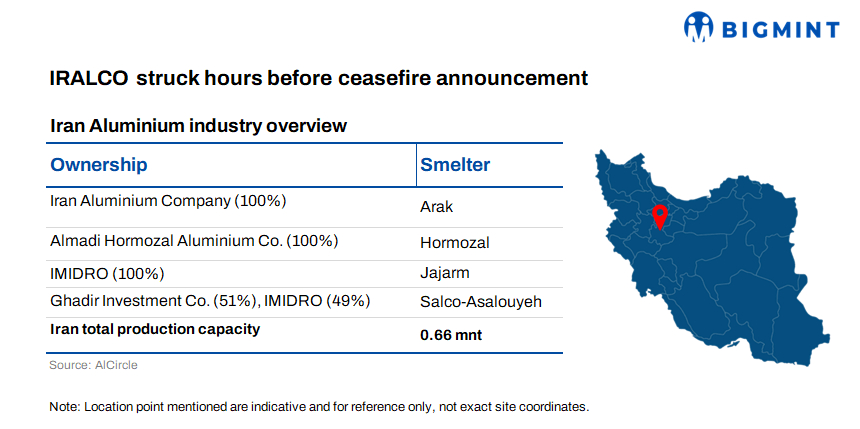
Located in Arak, IRALCO is Iran's largest aluminium producer, with an annual production capacity of approximately 160,000 to 200,000 tonnes (t). As aluminium plays a critical role in defence and manufacturing, the disruption of operations at the country's primary smelter places significant pressure on its industrial and strategic capabilities.
Beyond primary aluminium, Iran's upstream supply chain also reflects structural dependencies. The country has only one alumina refinery, which is integrated with domestic bauxite mining operations. Annual alumina production stands at around 250,000 t, while bauxite output is approximately 650,000 t. However, this alumina capacity is insufficient to meet the requirements of Irans electrolytic aluminium sector, resulting in a consistent reliance on imports. India remains the dominant supplier, accounting for an estimated 40-80 per cent of Iran's total alumina imports.
Despite this upstream constraint, Iran's downstream aluminium production remains relatively strong. The country operates four aluminium smelters, all currently running at an average utilisation rate of over 90%. Total annual aluminium output exceeds 600,000 t, surpassing domestic consumption levels. As a result, Iran maintains a net export position, with 30-50 per cent of its production exported primarily to Turkiye, China, and other international markets.
In a separate incident, the Amirkabir Petrochemical Complex in Mahshahr, situated in the southwestern Khuzestan province, was also struck. According to the Deputy Governor, the facility was hit in an aerial attack on April 7 at approximately 11:40 PM local time (8:10 PM GMT).
While both facilities sustained damage, authorities have not reported any casualties.
The developments signal a shift in targeting strategy, with strikes extending beyond military, transport, and energy infrastructure to include critical industrial hubs. Such actions appear aimed at weakening Irans strategic production capacity and broader defence resilience.
These attacks follow earlier escalations in the conflict. Since March 28, Iran had launched drone and missile strikes targeting aluminium smelters operated by Emirates Global Aluminium (EGA) in the UAE and Aluminium Bahrain (Alba), further intensifying disruptions across the regional metals industry.