
14-April-2026
- India ADC12 prices surge up to 20% m-o-m in Apr'26
- Wide bid-offer gaps emerge as buyers aggressively resist high offers
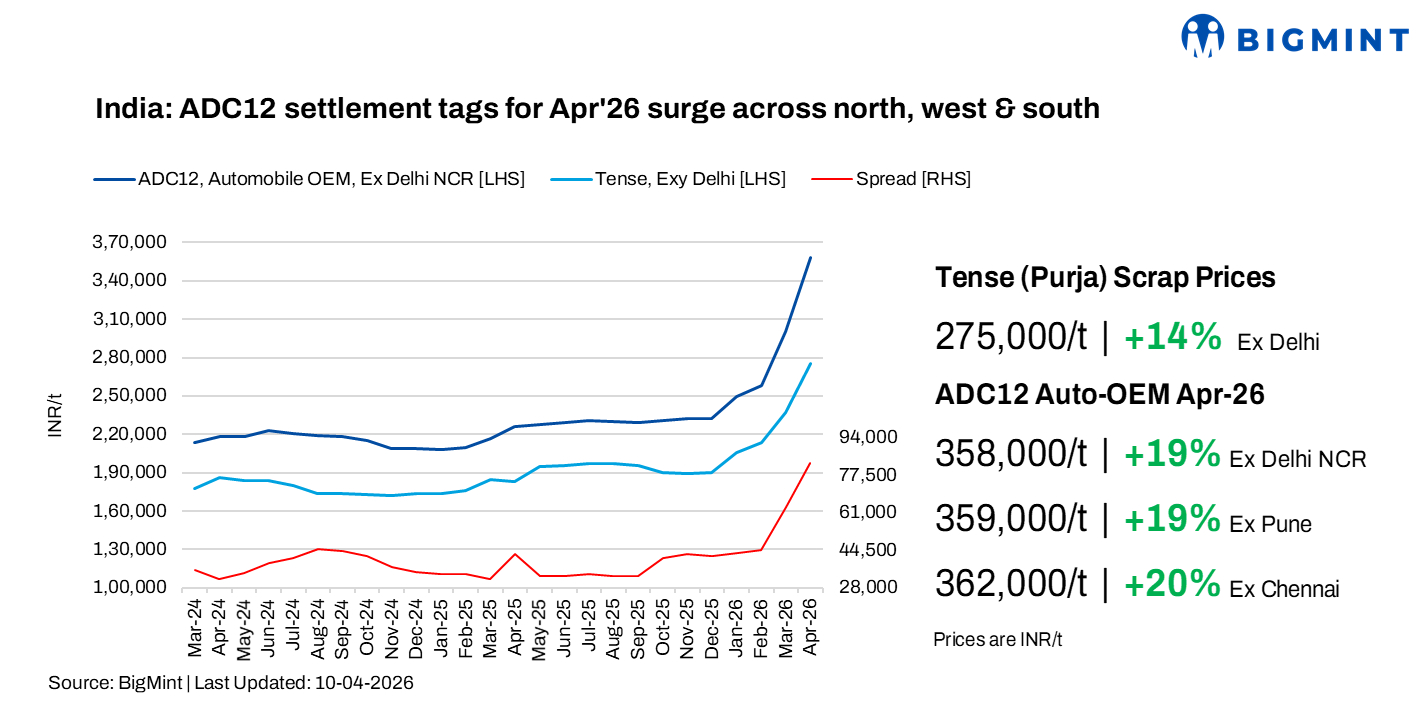
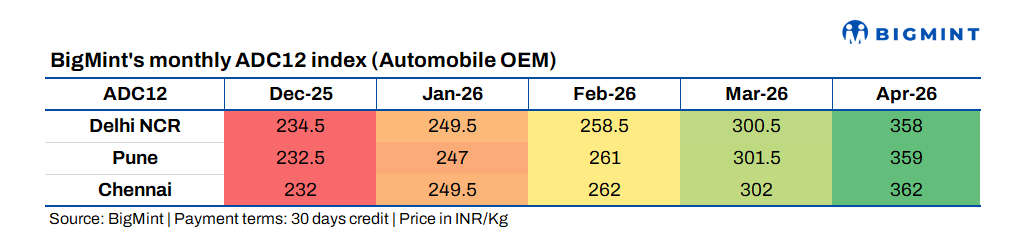
India's aluminium ADC12 alloy ingot prices rose sharply m-o-m in April 2026, driven by higher raw material costs and continued strong demand from the automotive sector.
The spread between scrap and semi-finished products also widened, averaging around INR 82,000-84,000/t in both Delhi NCR and Chennai. This was primarily due to a significant increase in ADC12 prices, while scrap rates saw only a moderate uptick.
Market insights
Early April 2026 price trends indicate a clear divergence between supplier expectations and buyer bids across regions. On a pan-India basis, supplier offers for ADC12 with 30-day payment terms were reported in the range of INR 370,000-380,000/t, rising sharply from INR 330,000-335,000/t seen in late March. However, OEMs continued to negotiate aggressively, with target settlement levels largely in the range of INR 320,000-340,000/t.
In Delhi NCR and Pune, supplier offers were heard at comparatively lower but still elevated levels of INR 360,000-370,000/t, while buyer bids remained significantly lower at INR 330,000-340,000/t. This has resulted in a persistent and wide negotiation gap, reflecting resistance from buyers amid rapidly rising costs.
In the southern region, including Chennai, supplier offers were broadly aligned with the all-India trend at around INR 360,000-380,000/t, while buyer targets remained in the range of INR 320,000-340,000/t.
Supply-side constraints, particularly LPG shortages impacting secondary producers, have further supported higher offer levels in the region despite continued pushback from buyers.
Anorth India-based secondary producer stated that LPG supply is currently stable and uninterrupted; however, this consistency is coming at a higher cost, with buyers needing to pay a premium to ensure reliable availability.
Alloy imports plunge m-o-m
Imports: Meanwhile, India's ADC12 alloy imports recorded a sharp uptick in 2MCY'26, rising by over 50% y-o-y to 840 t from 550 t in the corresponding period last year. The increase was largely driven by firm domestic prices, prompting buyers to explore overseas sourcing options. Malaysia remained the sole supplier, supported by FTA benefits.
However, import dynamics continue to be constrained. ADC12 offers from Malaysia are now nearing $3,580/t at Chennai port, and stringent payment terms, including 100% advance, are limiting broader participation from auto companies and OEMs, despite underlying demand remaining firm.
Exports: Outbound volumes from India have remained negligible, as strong domestic demand continues to absorb most of the available supply. Tight availability of ADC12, coupled with rising consumption, has prompted suppliers to prioritise allocations within the domestic market over exports.
A leading north India-based secondary producer stated that there is currently no surplus material available for export, with tight domestic supply limiting any outbound volumes.
Raw material trends
In April, imported aluminium scrap prices moved higher, supported by firm average prices on the London Metal Exchange (LME) at around $3,477/t amid supply-side concerns and escalating geopolitical tensions in the Middle East. In line with imported scrap trends, domestic aluminium scrap prices -- particularly casting-grade material used in ADC12 production -- also strengthened, as availability tightened, especially in southern India.
Among key imported grades, US-origin Tense increased by $130/t m-o-m to $2,540/t, while UK-origin Wheel scrap rose by $95/t to $3,255/t.
Meanwhile, China-origin silicon metal 553 prices increased by $20/t, rising to $1,401/t on a CFR Mundra basis, supported by steady demand.
Outlook
ADC12 prices are expected to remain firm to bullish across India, supported by tight scrap availability and ongoing LPG constraints impacting secondary producers. OEMs continue to resist higher offers amid supply-side pressures, and elevated input costs are likely to keep the market well supported. Any further disruption in Gulf output could add to volatility and push prices higher.