14-April-2026
- HCL achieves record production and operational growth in FY'26
- Expansion plans accelerate amid rising copper import dependence
Hindustan Copper Limited (HCL), Indias only integrated copper mining company, reported a strong operational performance in FY 2025-26, driven by higher production, improved efficiencies, and steady progress in strategic projects.
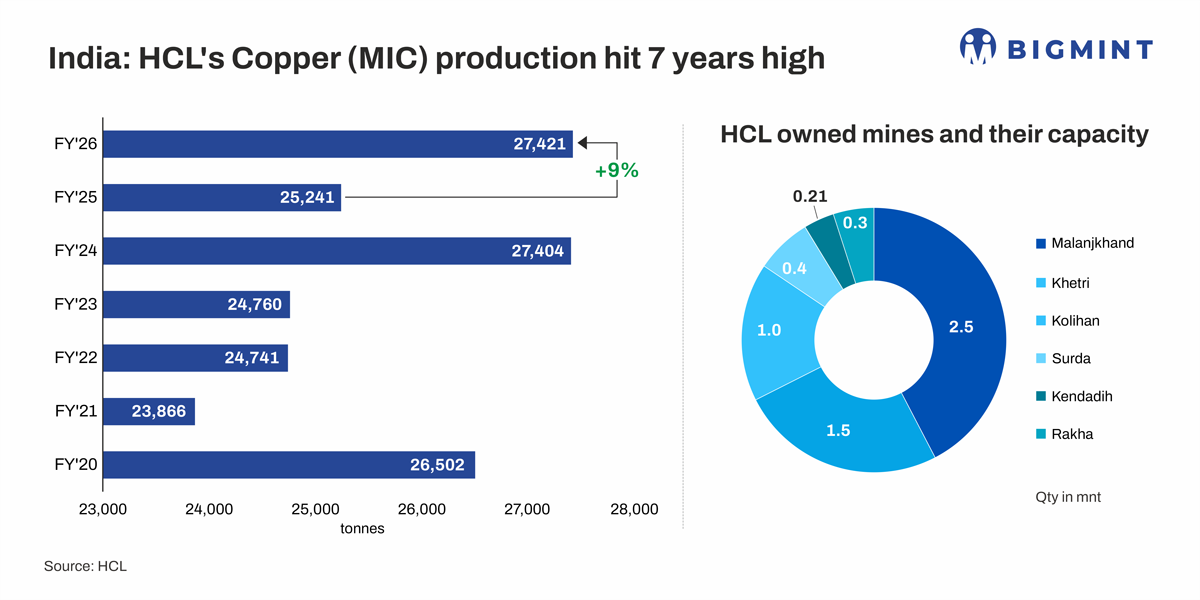
HCL recorded Metal in Concentrate (MIC) production of 27,421 tonnes in FY'26, reflecting a 9% year-on-year increase and marking the highest level achieved in the past seven years. Sales performance remained equally robust, with 27,367 tonnes of copper MIC sold which is the highest in the last five years, indicating stable demand and efficient offtake.
The company also achieved ore production of 3.67 million tonnes during the year, registering a 6% increase compared to FY'25. This growth was supported by enhanced mining activity, operational optimization, and the resumption of key mining assets.
Strategic Expansion and Capacity Enhancement Initiatives
HCL strengthened its production base by resuming operations at the Kendadih, Kolihan, and Surda mines, while also entering auction-based mining through the Sidhi Copper Block and progressing on key clearances, including Chandmari. In line with its growth strategy, the company is advancing greenfield projects in Sikkim, Dhobani, and Pathargora, alongside exploring international opportunities in Chile to expand its resource base and production capacity.
A major step toward strengthening upstream and processing capabilities was taken with the approval of a capital investment of INR 469.55 crore for the development of a 3.0 million tonnes per annum (mtpa) copper concentrate plant at its flagship Malanjkhand mine in Madhya Pradesh. The project is central to the company's long-term strategy to enhance domestic copper concentrate availability and reduce import dependence. Currently operating at around 4 million tonnes per year, HCL plans to scale up its ore production capacity to 12.2 million tonnes per year in a phased manner by 2030, with Malanjkhand playing a pivotal role in this expansion.
The new plant is expected to optimize throughput, reduce processing bottlenecks, and improve overall productivity. The EPC contract has been awarded to Ardee Engineering, ensuring efficient execution and technical expertise.
India's copper imports dependence remains high
Despite improvements in domestic production, India's dependence on imported copper concentrate continued to increase in CY'25. Even as HCL achieved its highest MIC production in seven years, the gap between domestic supply and consumption remains significant.
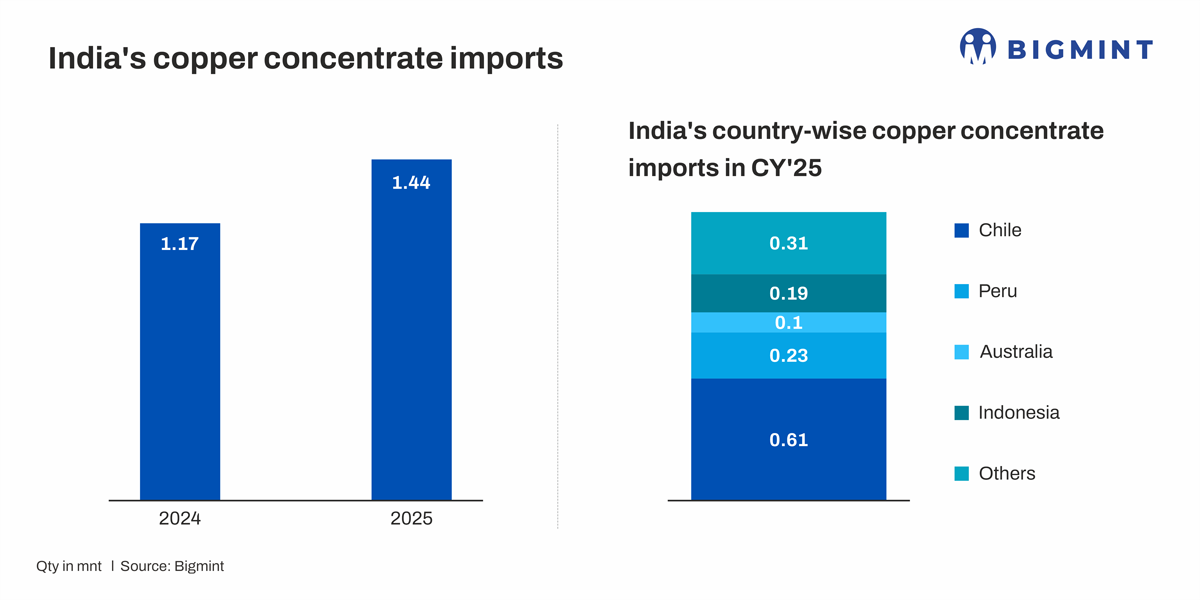
India's copper concentrate imports rose to 1.44 mnt in CY'25, compared to 1.17 mnt in CY'24, reflecting an approximate 23% y-o-y increase. This trend highlights the structural imbalance in the domestic copper ecosystem, where production growth has not kept pace with rising demand.
HCL, despite being India's only copper mining company, contributes only around 4% of the country's total MIC requirement, while nearly 96% is met through imports. This imbalance underscores the limited scale of domestic mining relative to India's expanding refining capacity and consumption needs, especially following significant investments in smelting infrastructure in recent years.
Country-wise data shows that Chile remains the largest supplier of copper concentrate to India, contributing approximately 0.61 mnt in CY25. It is followed by Peru with 0.23 mnt, Indonesia at 0.19 mnt, and Australia at 0.10 mnt, while other countries collectively account for 0.31 million tonnes of total imports.
Rising demand drives higher import dependence
India's copper demand has been witnessing strong growth, driven by rapid expansion in infrastructure, transportation, manufacturing, and the increasing adoption of electric mobility. Key sectors, particularly electric vehicles (EVs) and urban infrastructure, continue to register strong growth, leading to a surge in copper consumption.
However, despite ongoing efforts to ramp up production, domestic output remains limited. This has resulted in a widening gap between demand and supply, making imports of copper concentrate and scrap essential to support refining capacities and downstream consumption.
The trend highlights a structural imbalance in India's copper value chain, where rising demand consistently outpaces domestic mining growth. As a result, imports continue to play a crucial role in ensuring raw material security for the industry.
Conclusion
Going forward, HCL aims to strengthen its operational capabilities, enhance sustainability practices, and create long-term stakeholder value. The company remains focused on progressing toward its Vision 2030 goals and its aspiration of achieving Navratna status, while playing a critical role in reducing Indias dependence on copper imports.