India: Sponge iron prices decline m-o-m across regions in Oct'26 amid weak steel demand
...

- Lower semis, finished steel prices exert downward pressure on sponge iron
- Cautious procurement, festive season slowdown limit market recovery
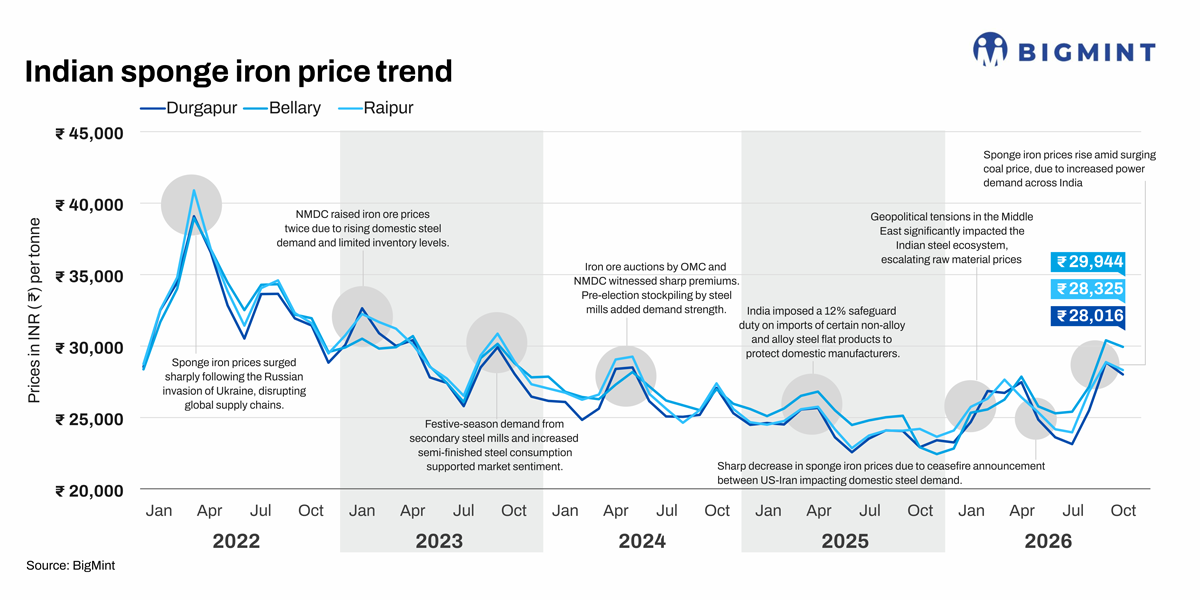
India's sponge iron market remained under pressure in October 2026, with monthly average prices declining across major producing and consuming regions amid subdued finished steel demand and festive-related disruptions. Prices fell in Raipur, Raigarh, Durgapur, Rourkela, Bellary and Mandi Gobindgarh, although the extent of correction varied across markets.
Buyers restricted procurement to immediate requirements amid weak steel demand, while producers faced limited scope to pass on higher input costs. Although buying interest improved marginally towards the month-end through selective restocking, the recovery remained insufficient to support a broad-based price reversal.
 Regional prices decline across major markets
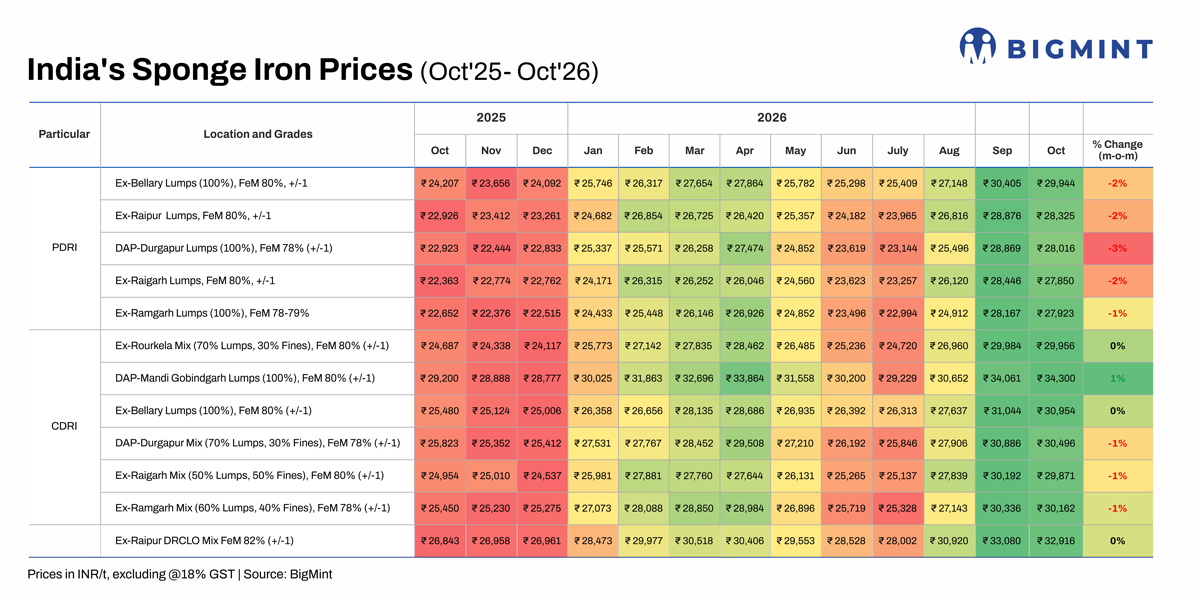
Central India recorded a correction in monthly average pellet-based direct reduced iron (PDRI) prices across Raipur and Raigarh. In Raipur, prices declined by INR 584/tonne month-on-month (m-o-m) to INR 28,292/t, while Raigarh prices fell by INR 614/t to INR 27,832/t.
Subdued procurement from secondary steel producers, particularly induction furnace operators, weighed on prices as corrections in billet and finished steel markets reduced buyers incentive to replenish inventories. Navratri and Dussehra holidays affected trading, transportation and dispatch schedules, while power interruptions in Chhattisgarh during early October disrupted operations at both consuming and producing units.
In eastern India, Durgapur PDRI prices declined by INR 853/t m-o-m to INR 28,016/t in October from INR 28,869/t in September. Rourkela recorded a relatively smaller correction of INR 66/t to INR 29,918/t from INR 29,984/t. Festival-related inactivity during Durga Puja and lower procurement from downstream units contributed to the decline.
Southern India also witnessed a sharp correction, with Bellary sponge iron prices falling by around INR 2,000/t m-o-m. Weak steel mill procurement and frequent power outages in supplying and consuming markets affected operations and buying activity. Despite margin pressure, most sponge iron plants in the region continued operating at near-full capacity, keeping availability comfortable. Some producers may consider temporary production halts if margins fail to improve.
In northern India, Mandi Gobindgarh sponge iron prices declined by approximately INR 2,200/t m-o-m, with the monthly average settling at around INR 34,300/t DAP. The market remained sensitive to freight costs and the competitiveness of supplies from Eastern India.
Weak downstream demand keeps procurement cautious
Subdued demand from finished steel manufacturers remained a key factor behind the decline in sponge iron prices. Lower offtake in rebar and billet markets reduced procurement requirements among secondary steel producers, particularly induction furnace operators. Buyers largely avoided bulk purchases and preferred need-based procurement amid uncertainty over finished steel prices and demand.
Festive holidays, including Dussehra and Durga Puja, further affected trading activity, dispatch schedules and transportation in Central and Eastern India. Power supply interruptions in Chhattisgarh also affected induction furnace and rolling mill operations, limiting sponge iron consumption.
In northern India, comfortable scrap availability further restricted sponge iron demand. Large steel mills generally maintained a scrap-to-sponge iron consumption ratio of around 90:10, while medium-sized mills operated with a higher sponge iron share of approximately 30%, using a 70:30 mix. Greater reliance on scrap among larger mills limited their requirement for sponge iron.
Buying interest improved marginally towards the end of October through short-term restocking. However, the improvement remained selective and did not translate into sustained procurement across consuming regions.
Higher coal costs outweigh pellet price relief
Raw material costs remained a major challenge for sponge iron manufacturers during October. Imported non-coking coal prices increased, offsetting the relief from lower raw pellet prices and adding to production cost pressures.
In eastern India, imported South African RB2 (5,500 NAR) coal prices on an ex-Paradip basis increased by INR 1,115/t m-o-m, while RB2 (4,800 NAR) prices rose by around INR 973/t. Domestic coal procurement also remained expensive, with Eastern Coalfields (ECL) auctions recording premiums of 100-200%, reflecting firm imported coal prices and limited domestic coal availability.
Eastern region plants generally maintained a domestic-to-imported coal blend of around 70:30 to 80:20, depending on availability, coal quality and procurement economics. In contrast, raw pellet prices declined by INR 305/t m-o-m to INR 10,061/t in October from INR 10,366/t in September. However, the reduction was insufficient to offset the increase in coal costs.
With higher input expenses coinciding with weaker sponge iron and finished steel realisations, Eastern Indian producers faced estimated losses of around INR 1,500/t. Sellers remained under pressure to liquidate inventories, resulting in competitive offers despite elevated production costs.
Regional production and availability remain mixed
Production conditions varied across regions depending on operating economics, power availability and inventory positions. In central India, significant margin pressure encouraged selective production adjustments across the Raipur and Raigarh clusters. Some manufacturers reassessed their product mix, shifting greater focus towards CDRI lumps and low-phosphorus sponge iron to improve product realisations and cater to specific buyer requirements.
In Bellary, most sponge iron plants continued operating at near-full capacity despite pressure on margins. However, producers could consider temporary production halts if operating economics deteriorate further.
In eastern India, sellers remained under pressure to liquidate stocks, while moderate export enquiries from Nepal and Bangladesh provided limited support to market activity. Overall, regional availability was influenced by production adjustments, power disruptions and inventory positions, while subdued buying continued to slow material movement.
Freight costs constrain northern market procurement
Mandi Gobindgarh remained dependent on supplies from eastern India, particularly West Bengal and Odisha, as the region has no significant local sponge iron production base. Freight costs from eastern production centres were estimated at INR 3,500-4,200/t.
Supplies from Rourkela generally comprised around 70% lumps and 30% fines, with approximately 80% FeM content. These supplies averaged around INR 29,900/t ex-works Rourkela during October. However, high freight costs reduced the competitiveness of eastern material in Mandi Gobindgarh, particularly amid weak finished steel demand and comfortable scrap availability. This further discouraged fresh sponge iron bookings.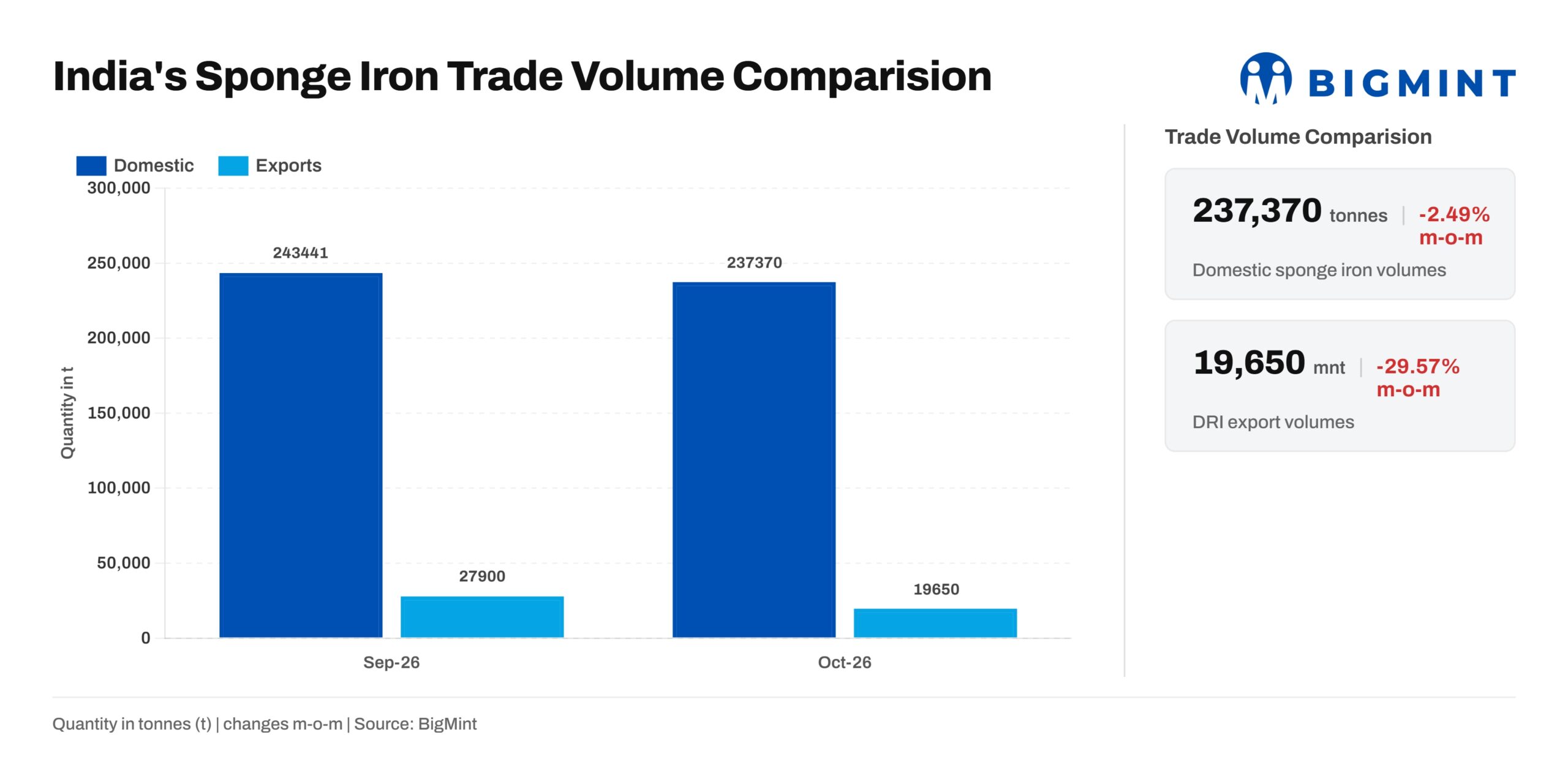 Export enquiries provide limited support
Indian sponge iron export offers to Nepal recorded mixed movements during October, while quotations to Bangladesh remained largely unchanged on a monthly basis. Buying interest from both destinations improved marginally towards month-end following festive holidays, supported by short-term restocking and forward bookings.
Towards the end of October, pellet-based DRI offers to Nepal declined by $5/t m-o-m to $318/t CPT Raxaul, while CDRI/mix sponge iron offers increased by $1/t to $348/t CPT Raxaul. Offers to Bangladesh remained stable at $362/t CPT Benapole.
The mixed price movement reflected differences across product grades, while overall overseas buying remained subdued. Export enquiries provided some support to sellers but were insufficient to offset weak domestic procurement.
Outlook
Sponge iron buying activity across India may improve during November as transportation and dispatch operations normalise following the festive holidays. Post-festival restocking by secondary steel manufacturers could support fresh enquiries, particularly in the Raipur, Raigarh and Durgapur clusters.
However, a sustained price recovery will depend on improved finished steel demand and better procurement from downstream units. Manufacturers are likely to continue optimising product mixes and regulating production wherever operating margins remain unfavourable.
If coal costs remain elevated while sponge iron and finished steel prices stay under pressure, producers could face further margin compression, potentially prompting additional production adjustments. In northern India, demand will also remain sensitive to scrap prices and the landed cost of eastern supplies. Overall, november market improvement will depend on the extent of downstream restocking and whether higher input costs can be absorbed through better product realisations.
