India: Ambuja Cements targets production capacity of 155 mnt/year by FY'30
...
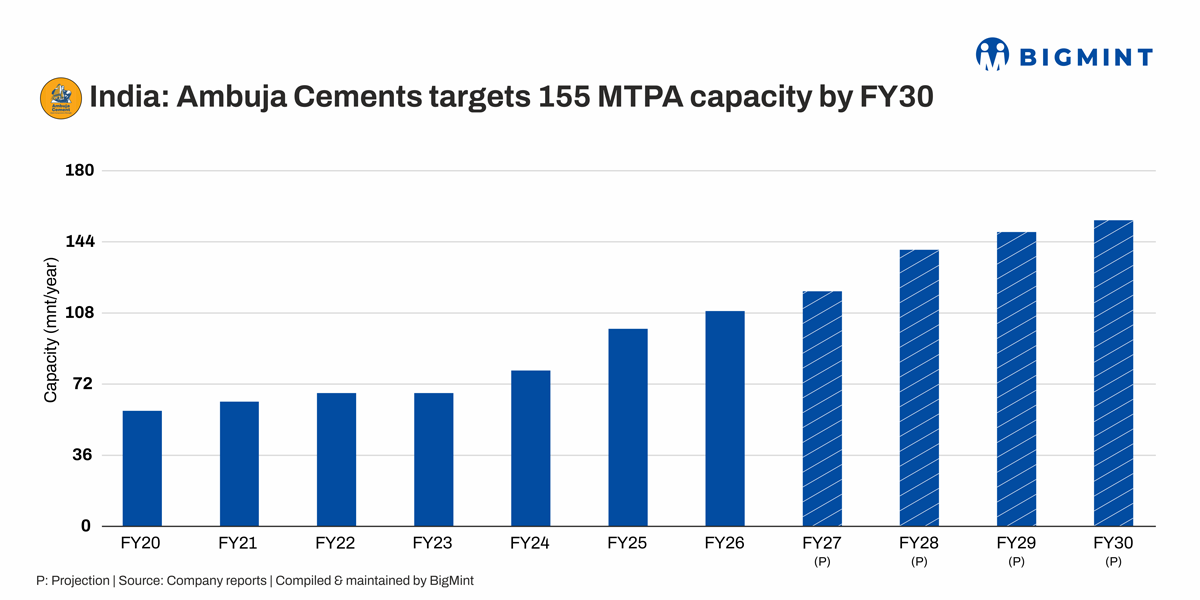

- Company earmarks INR 14,500 crore for expansion across six states
- Existing consolidated capacity stands at 113 mnt as of Sep'26
Ambuja Cements plans to add 29.7 million tonnes per annum (mnt/year) of cement capacity by FY'30, taking its consolidated manufacturing capacity to 155 mnt/year. The proposed expansion involves an estimated investment of INR 14,500 crore and will cover Uttar Pradesh, Maharashtra, Gujarat, Bihar, Jharkhand, and Assam. The programme is aimed at strengthening the company's manufacturing footprint and positioning capacity closer to key consumption centres.
Expansion plans cover six states
The proposed capacity additions will build on Ambuja Cements' recent commissioning of a 2.4 mnt/year grinding unit at Salai Banwa in Uttar Pradesh and a 1 mnt/year facility at Kalamboli in Maharashtra. These projects have taken the company's consolidated cement capacity to 113.45 mnt/year as of September 2026, compared with around 109 mnt/year in FY'26. The planned 29.7 mnt/year expansion is expected to take total capacity to 155 mnt/year by FY'30.
The investment programme spans six states, allowing the company to expand its presence across northern, western and eastern India. However, the project-wise capacity allocation, commissioning schedule and individual investment details have not been specified in the information provided.
Regional footprint and logistics efficiency
The expansion strategy places emphasis on strengthening production capacity closer to major cement consumption markets. Regional grinding facilities can help reduce transportation distances, improve delivery timelines and enhance supply efficiency.
Freight is an important component of delivered cement costs. A wider manufacturing network could therefore help the company improve regional competitiveness and serve dealers and infrastructure projects more efficiently.
The planned additions also reflect the company's focus on preparing for demand from housing, highways, industrial development and infrastructure projects. However, the pace of capacity utilisation will depend on actual demand growth and the company's ability to expand its distribution network.
Outlook
With existing capacity at 113.45 mnt/year and a target of 155 mnt/year by FY'30, execution will be central to the expansion strategy. Project approvals, construction timelines, raw material availability and fuel and freight costs will influence commissioning and operating performance. The ability to align new capacity with regional demand growth will be important for sustaining utilisation and returns.
