24-December-2025
- Steady gains in kharif output underline the state's role in national food security
- Diverse varietal base and GI-tagged rice add depth beyond bulk non-basmati production
India's rice output stood at about 150mn tonnes in the 2024-25 Kharif marketing season, with Chhattisgarh emerging as a key non-basmati producer. The state contributed roughly 10.37mn tonnes, accounting for nearly 7 per cent of national production.
In the ongoing 2025-26 season, India's rice output is estimated to have edged up to around 151mn tonnes. Chhattisgarhs contribution is currently assessed at 6-7mn tonnes, based on procurement data available so far, with final figures expected to firm up as purchases continue.
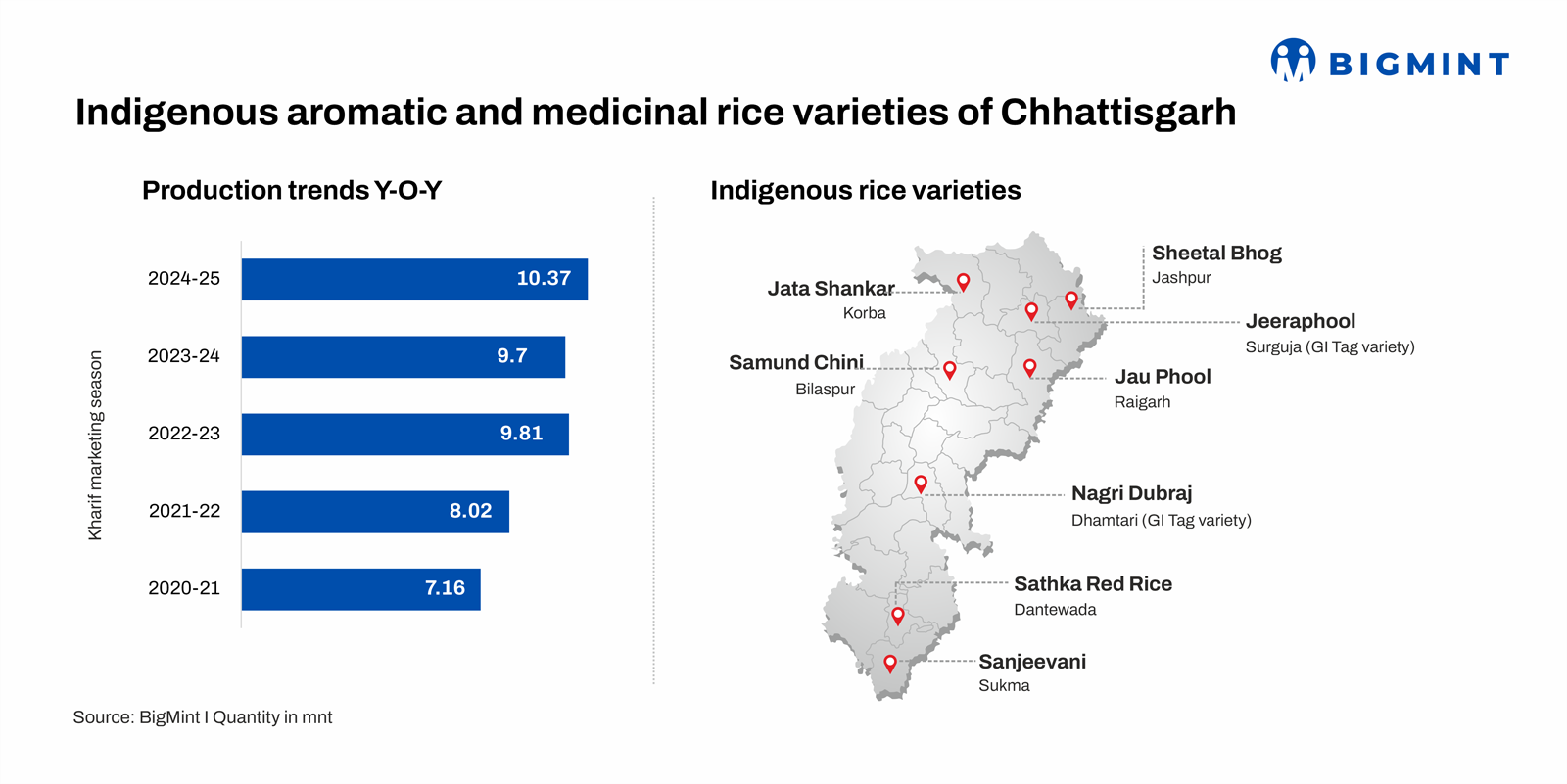
Chhattisgarh's kharif rice production has followed a steady upward trajectory over the past five seasons, underlining its position as one of India's most rice-intensive states. Output rose from 7.16mn tonnes in 2020-21 to 10.37mn tonnes in 2024-25, according to BigMint, supported by stable acreage, wider adoption of improved seed varieties and favourable monsoon distribution. Production crossed 9mn tonnes in 2022-23 and remained resilient at about 9.7mn tonnes in 2023-24 despite intermittent weather disruptions.
The sustained growth reflects the state's emphasis on higher-yielding varieties, improved agronomic practices and its central role in Indias public procurement system.
Key districts anchor the state's rice economy
Chhattisgarh, widely regarded as the rice bowl of India, is home to a rich diversity of indigenous rice varieties, many of which are valued for their aroma, texture, and therapeutic properties. Jeeraphool, a soft, aromatic short-grain rice cultivated in Surguja and the Northern Hills, is prized for its delicate fragrance and eating quality, while Nagri Dubraj, a traditional GI-tagged variety from Dhamtari, reflects the states strong varietal heritage. Raigarh's Jau Phool and Bilaspur's Samund Chini are known for their distinctive aroma, alongside Jata Shankar from Korba and Sheetal Bhog from Jashpur, both of which are scented varieties embedded in local consumption and culture.
In the southern tribal belts, Sathka Red Rice from Dantewada stands out for its medicinal value and high iron content, while Sanjeevani, originating from Sukma district, is traditionally associated with therapeutic and anti-cancer properties, underscoring the deep link between Chhattisgarh's rice biodiversity, nutrition, and indigenous knowledge systems.
GI-tagged rice adds niche value
Chhattisgarh is home to two prominent GI-tagged rice varieties Jeeraphool and Nagri Dubrajboth recognised for their distinct aroma, grain quality and geographical specificity. Jeeraphool, cultivated primarily in the Surguja region, is a short-grain aromatic rice known for its cumin-like fragrance, while Nagri Dubraj, grown in and around Dhamtari, is often referred to as the states equivalent of basmati due to its softness and aroma. GI recognition has helped preserve these indigenous varieties and improve farmgate realisations, though their contribution to overall production and exports remains marginal compared with bulk non-basmati rice.
Wide varietal basket underpins resilience
Beyond GI-tagged rice, Chhattisgarh cultivates a broad spectrum of traditional, aromatic and commercial varieties, reflecting its agro-climatic diversity. Indigenous grains such as Dubraj, Badshah Bhog, Vishnu Bhog, Jau Phool, Samund Chini, Gudma Dhan and Dumarphool coexist with widely grown commercial varieties including Swarna, Sona Masoori, Ponni, BPT and HMT, locally known as Sambha in parts of Dhamtari. Parboiled and white non-basmati rice dominate marketable surplus, while aromatic and heritage varieties cater primarily to regional consumption and niche markets.
Innovation and nutrition-led breeding gain ground
Recent varietal development has added a technology-led dimension to the state's rice ecosystem. Vikram TCR (VikramTrombay Chhattisgarh Rice), developed jointly by BARC and Indira Gandhi Krishi Vishwavidyalaya (IGKV), has gained attention for its short duration, drought tolerance and high yield potential of 60-75 quintals per hectare. The dwarf variety matures in about 120 days, reduces water usage and is well suited for puffed rice applications. Alongside fortified and nutrition-focused breeding initiatives, such innovations aim to address malnutrition concerns while sustaining productivity growth.
Overall, Chhattisgarhs rice sector continues to be driven by volume-led production, underpinned by a diverse varietal base and supported by incremental technological gains. While GI-tagged and specialty rice remain niche, they add strategic depth to a state that remains central to Indias rice supply matrix.
Discover deeper insights at the India International Rice Summit (IIRS), taking place on 9th - 10th January 2026 at Maira Resort, Raipur, Chhattisgarh.
Stay ahead of the curve; reserve your seat today.