14-April-2026
- Export mix may improve - less low-grade, more premium scrap
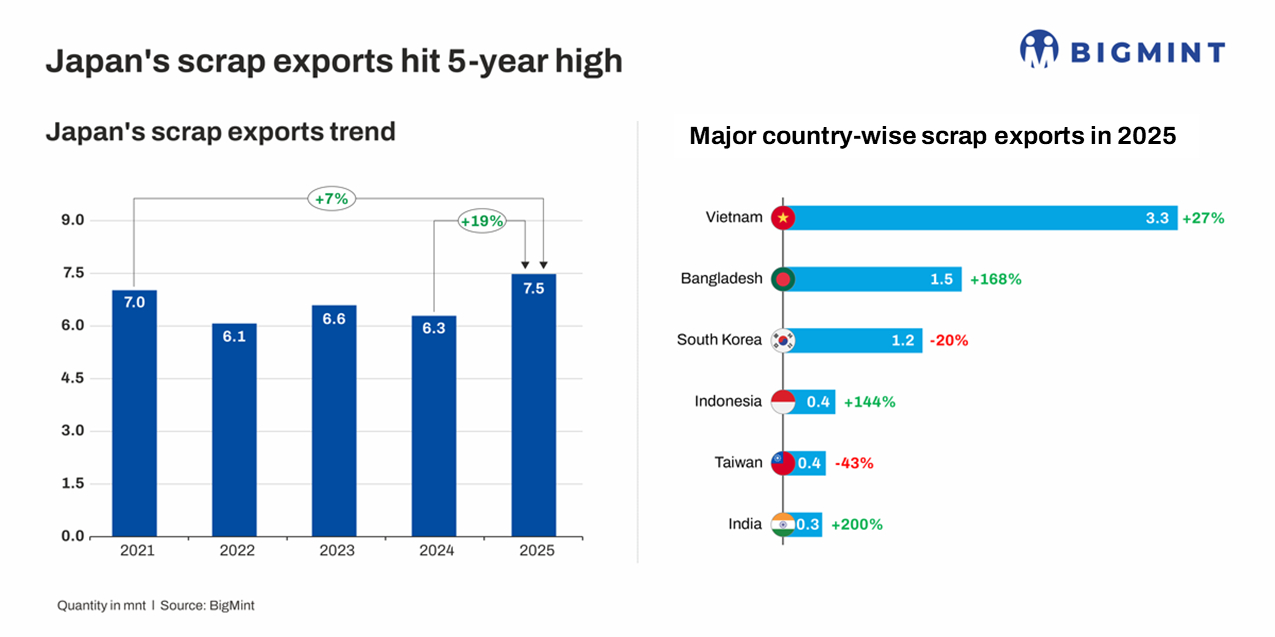
- Japan's ferrous scrap exports jumped to 5-year high in 2025
Japan is set to tighten regulations on the export of metal scrap and plastic waste, according to industry reports, as part of efforts to strengthen domestic recycling, improve environmental compliance, and enhance resource security. The proposed rules will cover metal scrap, plastic waste, batteries, and circuit boards, with stricter oversight aimed at preventing improper handling and pollution in overseas markets.
Companies violating the regulations may face penalties, while the Ministry of the Environment, along with other agencies, will strengthen export monitoring and traceability. Authorities highlighted that lax management at some recycling facilities has led to valuable recyclable resources being exported instead of being utilised domestically.
What it means for Japanese ferrous scrap exports?
Japan remains one of the largest exporters of high-quality ferrous scrap (H2 and premium grades such as HS and Shindachi) to Asia, particularly to Vietnam, Bangladesh, and South Korea. The country exported around 7.5 mnt in CY'25, up 19% y-o-y from 6.3 mnt in CY'24, as per BigMint data, marking a five-year high in export volumes.
Vietnam continued to be the top importer, while Bangladesh overtook South Korea and Taiwan to become the second-largest buyer in CY'25. 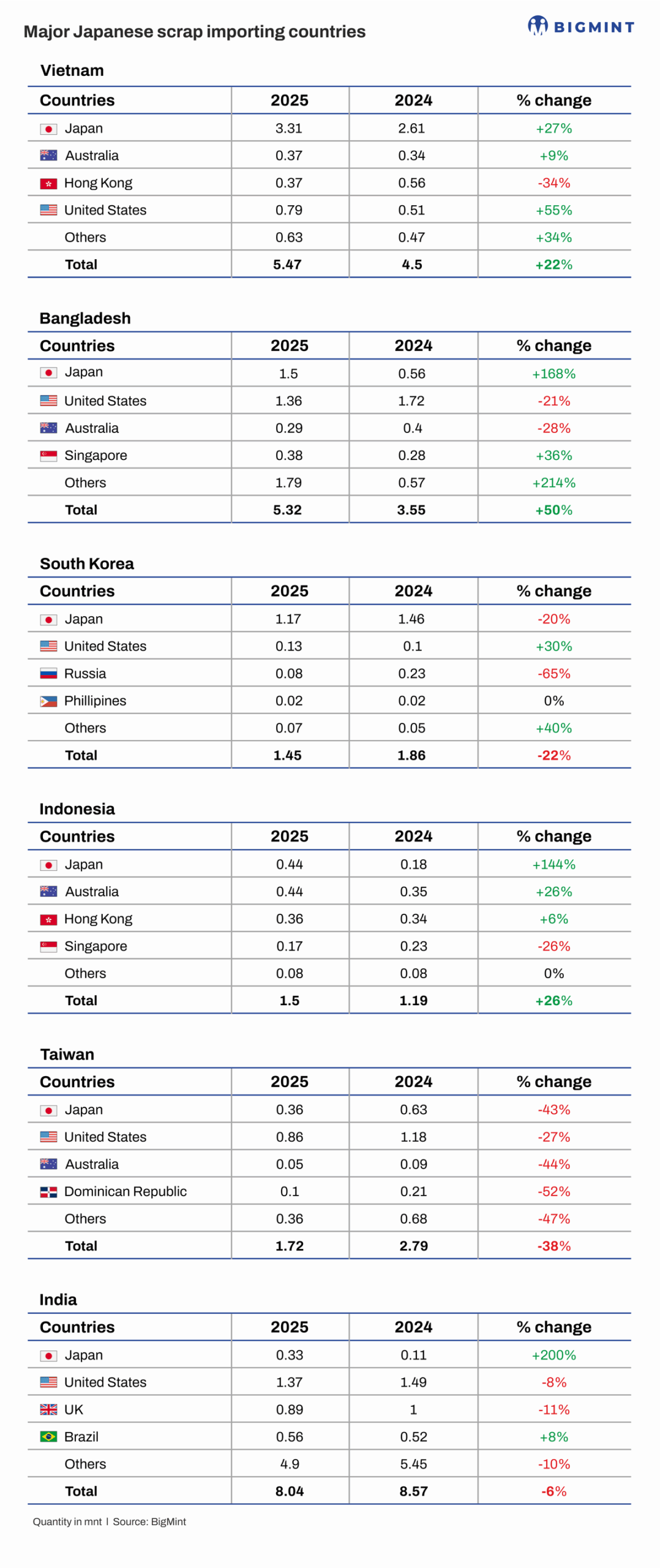
In coming months, Japan's scrap exports are not expected to drop sharply. High-quality material like H2--already clean and well-processed--should continue to move smoothly to key buyers such as Vietnam and Bangladesh.
That said, the impact will likely be gradual. The restrictions are mainly aimed at lower-grade and mixed scrap, so while premium exports remain steady, overall volumes could level off or ease slightly over time as more material stays within Japan.
What the market says
Market participants believe the proposed restrictions are unlikely to disrupt high-quality scrap flows in the immediate term. "The focus will largely be on low-grade or mixed scrap--clean, processed material like H2 should continue to move," a supplier noted.
That said, the broader impact is expected to be gradual. "Over time, volumes may stabilise or even soften slightly, as relatively more material is retained within Japan. That will also depend on domestic steel production and auto-sector demand," another source added.
At the same time, the export profile is likely to evolve. "This could actually improve the overall export mix--more processed, higher-quality scrap going out, and less lower-grade material," a scrap trader source said, pointing to a structural shift rather than a sharp decline in trade.
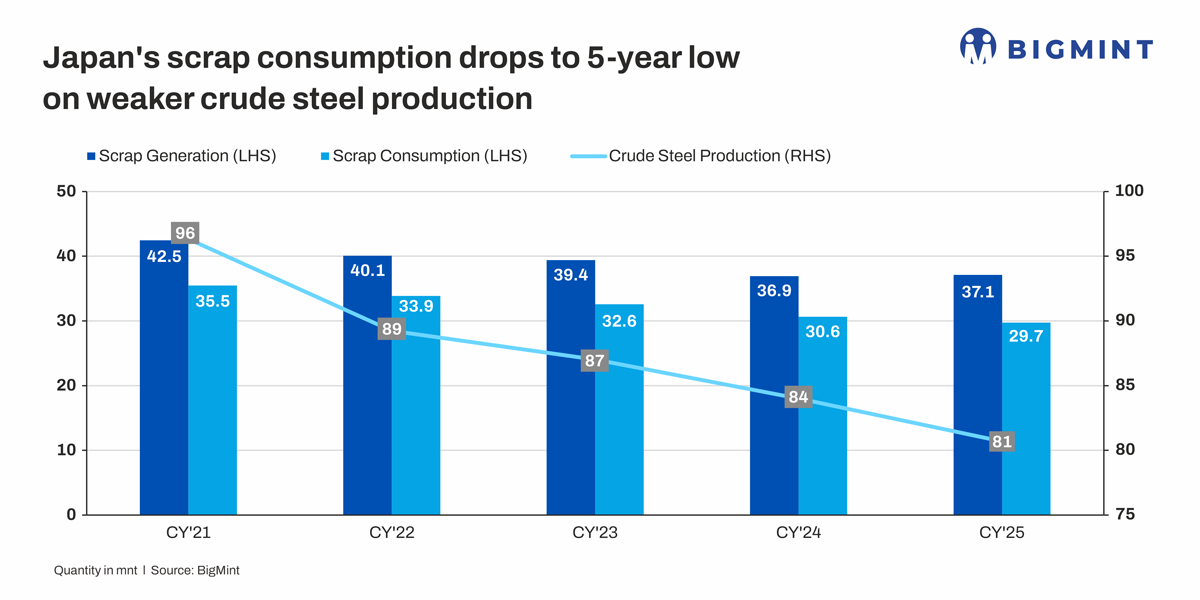
At the same time, increasing focus on circular economy policies is pushing governments, including Japan, to retain more recyclable material domestically. Scrap is increasingly being viewed as a strategic raw material, especially with the rise of decarbonisation efforts and EAF-based steelmaking.
Outlook
Japan's scrap-EAF producers are likely to continue with a business-as-usual approach, with limited expansion due to weak construction demand. Stable scrap availability should keep export flows steady. On the demand side, scrap usage may gradually improve, supported by GX (Green Transformation) initiatives, though progress remains slow amid uncertainty around green steel demand and energy costs.
Over the longer term, planned EAF capacity additions post-FY'28 could tighten scrap availability, especially for high-grade material like H2 and shredded, supporting prices while overall supply remains sufficient to sustain exports.