01-May-2026
- Producers must buy EPR certificates to fulfil targets
- New waste management rules broaden scope of classification
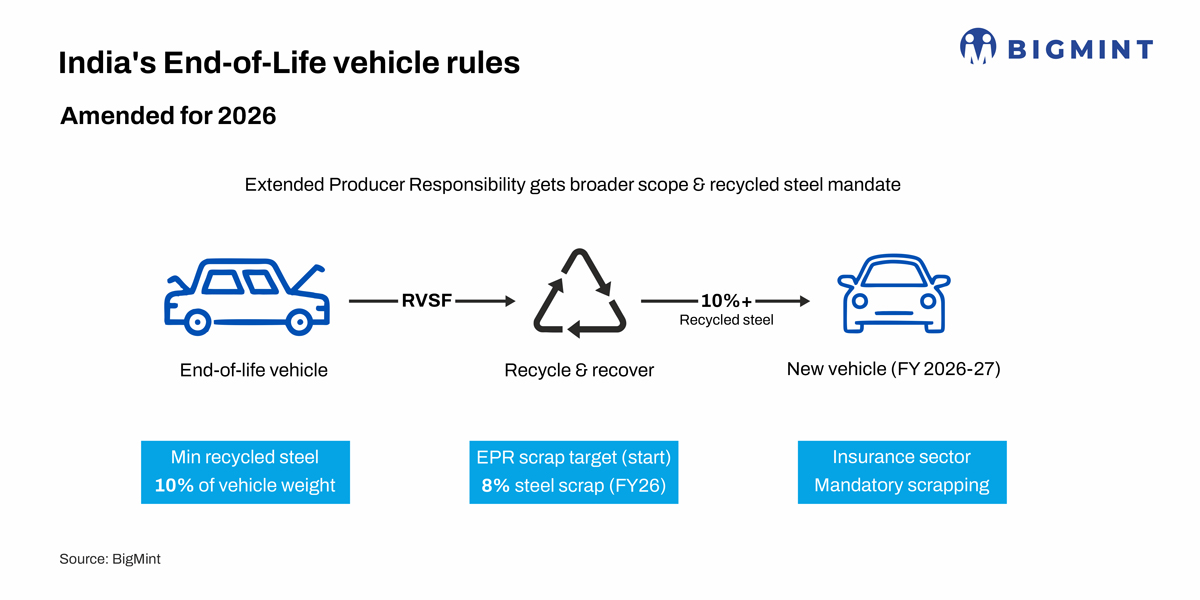
The Environment Protection (End-of-Life Vehicles) Amendment Rules, 2026, published on 27 March, 2026, propose significant changes to the original 2025 rules to enhance the Extended Producer Responsibility (EPR) framework for auto producers. These amendments aim to broaden the scope of waste management and mandate the use of recycled materials in new vehicle production.
What are the key changes?
Expanded scope of EPR obligations: Under the 2026 amendments, the definition of "waste management rules" is explicitly added to include EPR rules for the environmentally sound management of wastes notified under the Environment (Protection) Act, 1986.
- Wider waste categories: Producers are now responsible for fulfilling EPR obligations for a broader range of waste generated from End-of-Life Vehicles (ELV), including steel scrap, used oil, waste tyres, waste batteries, e-waste, and plastic waste.
- Certificate procurement: If EPR obligations for ELV waste are not met under other specific waste rules, producers must procure EPR certificates and meet targets as specified in these new rules.
Mandated use of recycled steel (new rule 9A): A major new requirement is the mandatory inclusion of recycled content in new vehicles. Starting from the financial year 2026-27, producers must ensure that a minimum of 10% of the total weight of steel used in a new vehicle (excluding fuel weight) is recycled steel. If a producer sources steel-containing auto parts from other manufacturers, they must obtain and furnish certificates from those suppliers confirming the use of recycled steel.
Enhanced reporting and data declaration: The amendments introduce stricter data submission requirements to track historical and current vehicle components. Producers must declare details of vehicles introduced to the domestic market from FY2005-06 to FY2024-25 by 30 June, 2026,. This declaration must include the weights of steel, tyres, oil, electronics, batteries, and plastics used in those vehicles.
Updated EPR targets for steel scrap: The schedule has been revised to provide specific weight-based EPR targets for both non-transport and transport vehicles. For non-transport vehicles the targets start at 8% of the steel used in vehicles from 20 years prior (for FY2025-26) and gradually increase to 70% for FY2055-56 onwards. For transport vehicles, targets similarly start at 8% of steel used 15 years prior and scale up to 75% for FY2050-51 onwards.
Generation of EPR certificates: The rules now specify that recyclers will generate EPR certificates on a centralised online portal for non-steel waste categories (oil, tyres, batteries, e-waste, and plastic) if such certificates are not already generated under other specific EPR regulations.