12-May-2026
- India continues to remain the top manganese alloy exporter in CY25
- Safeguards and CBAM to drive exports in CY26
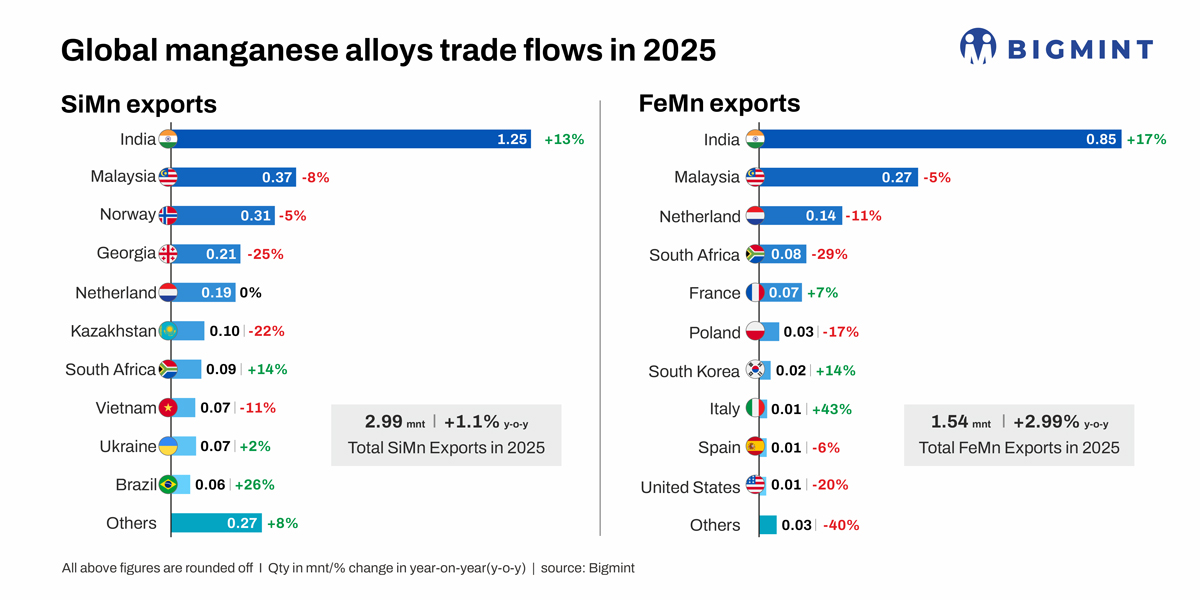
Global exports of Silico Manganese (SiMn) and Ferro Manganese (FeMn) rose 2% y-o-y in CY25 to 4.53 million tonnes (mnt), compared to 4.45 mnt in CY24, according to latest data available with BigMint.
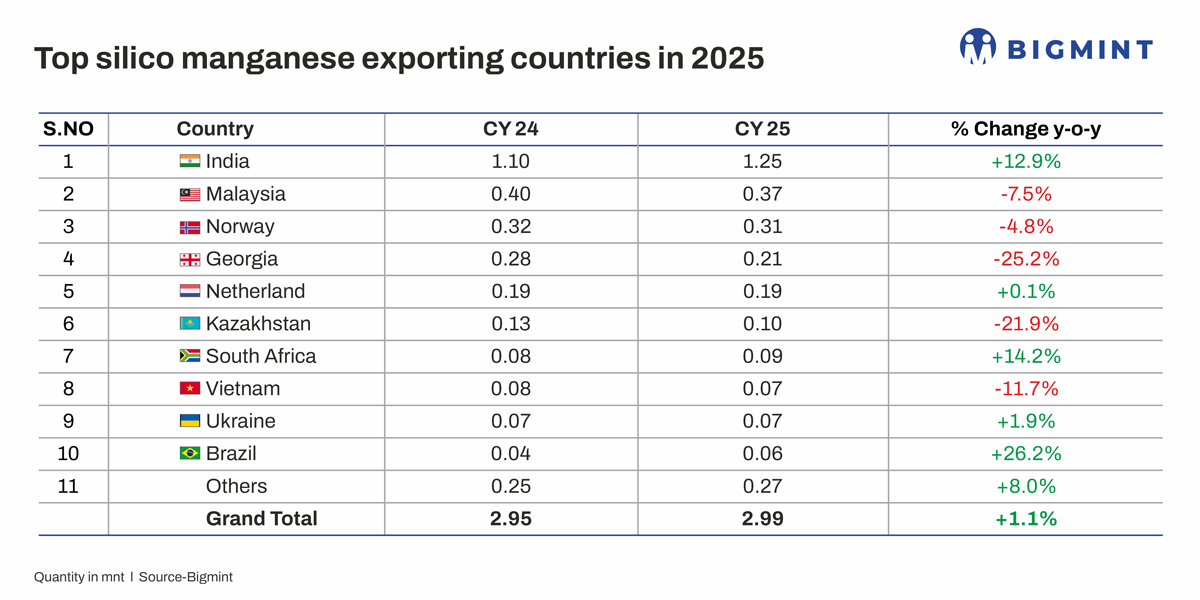
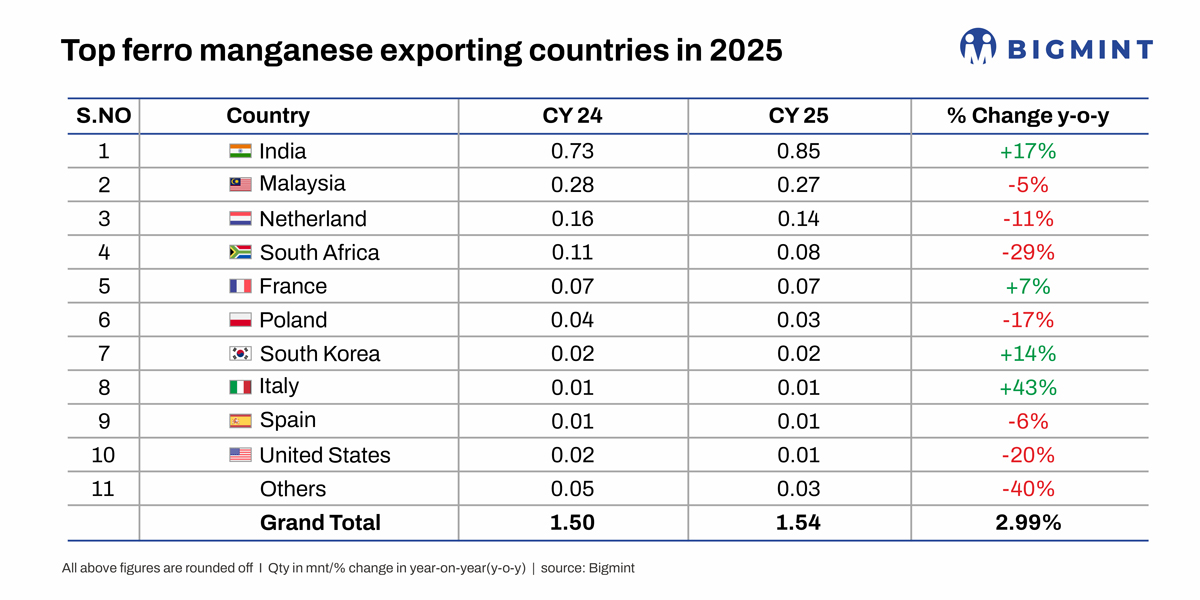
Global SiMn exports edged up to 2.99 mnt in CY'25 from 2.95 mnt in CY'24, reflecting sustained demand from construction steel producers across Turkey, Italy, United Arab Emirates, and Southeast Asia. In contrast, FeMn trade increased at a faster pace to 1.54 mnt from 1.50 mnt in CY'24, as weak foundry activity and sluggish engineering steel demand in Germany, Japan, and South Korea continued to weigh on consumption.
The divergence between SiMn and FeMn trade trends continued in CY'25 as steelmakers increasingly preferred SiMn owing to its dual manganese and silicon addition efficiency, making it more economical for bulk carbon steel production. FeMn, however, remained more dependent on specialty steel, foundry, and engineering sectors, which continued to face slower recovery.
Global manganese alloy trade reflects widening SiMn-FeMn demand gap
Indian SiMn shipments soar on higher output: India retained its position as the world's leading exporter of manganese alloys, supported by competitive production costs, improved furnace utilisation, and strong trade linkages with Europe and the Middle East. Indian silico manganese exports rose 13% y-o-y to 1.25 mnt in CY'25, driven by stronger shipments to Italy, which increased 33% to 0.12 mnt, Turkey, up 67% to 0.10 mnt, Japan, rising 18% to 0.13 mnt, and Bangladesh, which climbed 50% y-o-y to 0.06 mnt in CY25. Increased y-o-y crude steel production in Turkiye, Italy backed demand for silico manganese. Rise in exports was supported by increased Indian production, as India's silico manganese production grew from 2.8 mnt in CY'24 to 3.2 mnt in CY'25, as per BigMint data.
Meanwhile, Indian Ferro Manganese (FeMn) exports recorded 17% growth, as recovery in global industrial manufacturing and foundry demand remained uneven.
Malaysia records drop in manganese alloys exports on smelter's scheduled maintenance - Malaysia recorded 7.5% y-o-y drop in SiMn exports in CY'25, while its ferro manganese exports fell by 5%. One of Malaysia's leading producer, OM holdings reported a y-o-y drop in manganese alloys production and sales in CY'25. The decline in manganese alloy production resulted from downtime for scheduled major maintenance across multiple furnaces. In 2025, the average furnace operating rates for ferrosilicon and manganese alloys reached 98.5% and 96.4%, respectively.
Norway's silico-manganese exports drop on lower US intake - Norways silico-manganese exports saw a localised drop in 2025, driven by reduced demand from key markets like the USA. Norway's silico manganese exports to the USA fell from 0.03 mnt in CY24 to 0.02 mnt in CY'25. This volatility is driven by high production costs and strict environmental regulations. Notably, Norwegian Ministry of Climate and Environment (KLD) has concluded that Norwegian silicon, ferrosilicon and manganese producers were unequally treated compared to European Union producers in the allocation of free emission allowances under the EU Emissions Trading System (EU ETS) by the Norwegian authorities for the period 2021-2025.
South Africa pivots toward SiMn amid pressure on FeMn margins: Among competing suppliers, South Africa recorded a 14% y-o-y rise to 0.09mnt of Silico Manganese (SiMn) exports in CY25, supported by improved furnace utilisation, better ore availability, and higher export movement through rail and port infrastructure. In contrast, South African Ferro Manganese (FeMn) exports plunged 28.8% y-o-y amid weak industrial manufacturing activity.
Outlook
Global Mn alloy exports are expected to remain range-bound amid cautious steel mill procurement and tight margins. Silico Manganese (SiMn) is likely to outperform due to stronger infrastructure steel demand and better spot liquidity, while Ferro Manganese (FeMn) may remain under pressure from weak foundry demand and margin compression.
The European Commission has officially imposed definitive safeguard measures on imports of certain ferro alloys, concluding an 11-month investigation and stepping up efforts to protect the EUs ferro alloy industry, which employs about 1,800 workers. Each ferro alloy type will have a tariff rate quota (TRQ) per exporting country. These measures will be valid for 3 years and apply until 17 November 2028. This is likely to result in trade shifts, exploring newer markets and value added manganese alloy exports, which will drive the overall trades of manganese alloys in CY'26.
To know more on what's happening in global manganese ore and alloys industry, join the 6th International Ferro Alloys Conference (IFAC 2026) being organised by the Indian Ferro Alloy Producers Association (IFAPA) which will take place in Goa from 16-18 September 2026.